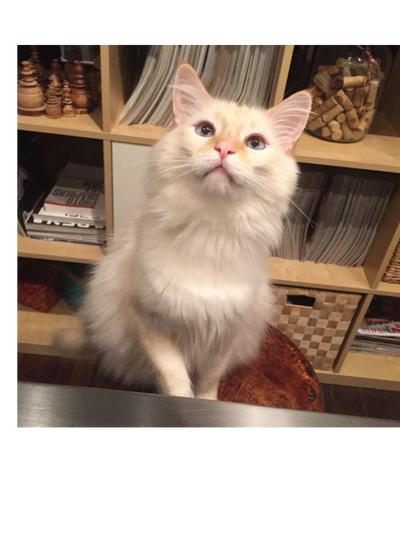
Dema
On Wednesday, June 10, 2026, Dema died at home with Katya and me beside him.
The first 48 hours were devastating. Katya and I were like a raw nerve, moving through shock, urgency, relief, disbelief, nausea, exhaustion, and the impossible understanding that Dema was gone.
In those first mornings, grief made me feel broken in a way I don’t think I’ve felt before. Not just sad, but mentally scattered. I burned butter waiting for eggs, took the carton out and put it back without ever removing the eggs, and turned on the coffee grinder right after removing the catch container. It shook my ability to function, and I’ve never been like that.
Since then, the pain has not exactly eased, but it has changed shape. We’ve spent almost every moment together, crying, laughing at small memories, going through his things, looking at photos and videos, and trying to protect his place with us. Writing this has helped too. It doesn’t make the loss smaller, but it gives us somewhere to put the love.
His absence has made the shape of his life with us crystal clear. Not that we didn’t already know how much we loved him, or how central he was, but there is something about the silence and the breaking of our routines that makes the structure so visible. Every facet of our day was always moving around him.
So that is where we are right now. Tired, raw, sometimes numb, sometimes hit with pain so fast it manifests as physical nausea. Trying to slow down. Trying to let it settle.
~
We met Dema in December 2015, at a shelter we visited with intent, but not expectation. We were looking for a cat, or at least open to finding one, but I don’t think either of us knew what we were walking into.
Katya had always wanted a kitten, a specific breed for sentimental reasons, but she was open to seeing who else was there and who might need a family. Dema had just arrived from California that morning. His paperwork wasn’t even complete yet. The shelter had briefly named him Frosty, which was a terrible name and clearly not his.
He was in a room with a dozen or more other cats needing homes. Most were scared, tired, cautious, defensive, or hostile. Dema was different immediately. He greeted us. He sought us out. He walked right up and introduced himself, then followed us as we moved around the room saying hello to the other cats. He even tried to say hello to them too, usually getting a hiss or swat in return.
It stood out instantly. He was social, sweet, confident in this very gentle way, and somehow already himself in a room full of uncertainty.
I remember pointing him out to Katya and saying something like, “Look at this little guy, I think I really like him.”
The rest was easy and obvious.
~
We brought him home to our building — an industrial artist loft conversion — which in those early years was very cat-centric. For a while there were definitely more cats living here than people.
People would leave their doors open, cats would roam the halls, wander into neighbors’ units, and create the usual cat conflicts and drama. But overall it was a wonderful social environment to introduce Dema to, especially because he was so affable.
A young silly girl cat from across the hall seemed to have a crush on him, though Dema didn’t seem particularly impressed with her shallow advances.
Over time the building changed. Neighbors came and went, doors closed, and there were fewer cats. Dema would still take brief strolls in the halls, which are wide and tall and seemed to amplify just how small his tiny personage was. He would call out loudly — a repetitive meow-scream that echoed around the floor like an alarm — as if asking, “is there anyone here?”
Katya and I would hurry to the door to make our familiar sounds and call him back in. But as the building became less open, I couldn’t help thinking how sad it was that such a sweet, pure, friendly soul didn’t have more opportunities to share himself.
I don’t think he felt particularly sad about it though.
~
Out of the three of us, Dema had the strongest sense of what core family really means. He loved each of us in his own way, with our own roles in his care, comfort, food, play, and routines, but he only ever seemed truly content or at ease when all of us were together, happy, and healthy.
That, more than anything, was what made him exceptional to us: not just that he loved us, but that he seemed devoted to the shape of us as a family.
He was deeply aware when one of us was away. If one of us came home later than usual, he would wait by the door or stay on alert, listening for our familiar steps coming down the hall. In thousands of returns home, there were probably only a few times he was not immediately up, meowing in excitement and delight, greeting us and welcoming us home. And even then, it was only because he was sleeping too peacefully.
He also understood shoes. When they came out, he knew we were leaving, and would often lie on or near them before we had to go, as if trying to say, don’t.
He worried when the bathroom door was closed, and would wait outside until we were done.
A favorite ritual was evening movie time, when he was never more relaxed, but he was also a stickler for schedules and insisted on bedtime at 10.
Mornings were the stricter version. He would militantly wake us around 6, or with the sunrise in summer, whether we wanted to or not, poking at us until we accepted that the day had started because Dema said so.
He was not needy. He had plenty of his own endeavors, naps, forts, grooming marathons, and personal time. But he was never distant in the way people sometimes expect cats to be. He was independent, but engaged.
He liked being invited to the table and placed on a stool, where he would sit politely, eager to join the discussion and inspect whatever was happening in front of him. His eyes alone would tell us what he wanted to know more about, and we would display or offer it for him to sniff and understand.
It’s hard to explain without making it sound too simple, but Dema kept the household oriented around togetherness in the practical, daily, repetitive ways that actually make up a life.
~
I’ve had cats all my life and try to be around them as much as possible. I love and appreciate all cats, and I think they make the world livable. But Dema was on another level.
Part of what made all of this so clear to us was how expressive Dema was. His face told us everything. His smiles were huge. His eyes had depth and range, and seemed to show us everything moving through him: happiness, concern, curiosity, impatience, comfort, and later, pain.
His movements said just as much. His graceful but subdued playful steps, the way he walked into a room, settled, looked up at us, or paused before deciding what he wanted — all of it had range. Small changes told us what we needed to know about his mind, his health, or what he needed from us.
It was just the way we lived together, our day-to-day conversation.
~
Dema was such a pure soul. We said that about him often, because there wasn’t really a better description.
He was a diligent master groomer. Always soft, always smelling incredible. His fur had this pure fresh baby smell mixed with laundry that we could never really quantify, except that to us it was literally the best smell in the world. Belly sniffs.
Somewhere along the way he became Boogers, or Mr. Boogers, because of the little dark eye crusts we were always helping him clean. It was not an elegant nickname, but it became one of the most tender names we had for him, especially when he was being impossibly cute and sweet.
He loved tuna. He had his vast selection of tasty things, and his enjoyment was our satisfaction.
He loved caves and finding new cozy hiding places. Drawers, cabinets, under blankets, closets. But for most of our life together he slept on the third pillow between us, right where he belonged.
When we held him, his claws would gently grip our bodies and leave what we called “Dema tattoos” on our shoulders. His work was never finished.
~
The garden became another part of his life.
I work 25 miles away, running a botanical garden and small nursery where my parents live. It gave my schedule flexibility, but it also meant I was gone all day for much of his life, so I brought Dema to the garden whenever I could. It was kind of like his vacation home: a place where he could escape the loud, hard space we live in Seattle, and be surrounded by nature.
He wasn’t adventurous or a true outdoor cat, but he naturally appreciated being there. Some of my most vivid memories are of him lifting his head, closing his eyes, and taking in the garden breeze. His expression is burned into my psyche.
His steps were different there, a gentle little bounding walk that always made me think of a hobbit off on an adventure.
Having him there, seeing him enjoy the garden, was easily among the best motivators I could have had in building it. He was certainly the cutest visitor the garden has ever known.
~
Dema also had an unchosen role that became pivotal in my life.
Over the last nine years since I started the garden, my stress levels rose, and my relationship with Seattle became strained, even though this is where I’m from and still what I think of as my true home. The commute took such a toll on my mental health that it corrupted my body. I injured my back, held the pain and stress there, and every trip back and forth became agony.
He became the release valve, a sponge that could absorb negative energy and turn it into warmth. It’s not a responsibility he deserved to bear, but it was nothing to him.
Just a hug, a kiss, a belly sniff, and I was reborn.
~
His illness should not define him, but it was part of his life, and part of ours.
For a long time, we thought he would bounce back, because he always had before. Or at least that the final turn was still somewhere far ahead. But over the last few weeks, I think his body crossed a threshold. He could not breathe well enough to rest, and he could not rest well enough to recover.
Early Monday morning I saw it. I couldn’t sleep, so I went downstairs and found him in his favorite chair, much as he had been on so many other mornings during his long stretch of issues. But he looked up at me, and I looked at him, and I knew. He was losing.
It was a singular heart-sinking moment. My optimism scattered. I went back to bed, where Katya was still sleeping. I was sobbing and shaking when I hugged her. Then she knew too.
He was already struggling by then. He had stopped eating and drinking, and had gone to his cave for peace.
But that day we had guests, and he still came out to greet them. He purred and socialized. For a moment, despite everything, he showed himself.
Later he worsened, and by Tuesday night his decline was rapid. Everything became about bearing the illness.
The vet was already scheduled to come to our home the next day, and the timing felt eerily perfect in the awful sense: it could not have been much sooner without unbearable doubt, or much later without failing to ease his pain as it became too much.
He passed within seconds, and looked as peaceful as he possibly could. We cleaned his body and talked to him, just as we had been all day, and just as we had done every day.
No goodbye kiss or length of time holding him would ever be enough. We knew he was gone, and we knew it had to happen, but knowing that did nothing to help us let go.
~
One thing I did not expect was the attachment to his remains. His fur, claws, whiskers, ashes. We always had some degree of “keep it” sentimentality, but I never expected the frantic need to have those things now.
It’s strange how much those pieces help, and how much they hurt. They are him, but not enough of him. Something we can still touch and smell and hold onto, while also being forced to understand exactly what is missing.
Once we have his ashes, I think we’ll want to put parts of him in places we love. Part of him in the garden feels right. Part of him resting peacefully high in the mountains we love feels right. Places we can visit, places that keep him close, places where some piece of him is still in the world.
~
Now it’s us, the absence, and whatever comes next.
Next week Katya and I are going to stay in the mountains, at a cabin by a river. We need to slow down and process, away from the normal distractions and reminders. The river feels right. The sound, the continuous flow, the way things keep moving whether you want them to or not.
It’s impossible not to think of how much he shaped the way we live. That sounds basic, maybe too Hallmark, but it doesn’t feel abstract. He was happiest when we were together, worried when one of us was away, and pulled us into movie time, bedtime, wake-up time, food time, all the little rituals that made up our life.
I think that is his last gift to us: not some invented message, but what he had been showing us the whole time. Stay close. Keep going. Live well enough that it would make him happy.
I feel gratitude for him, for the luck of finding him, for the time we had, for Katya, and for the life the three of us shared. We lost our best friend, our child, and an equal third leg of our relationship and life. We aspired to be good for him, learned from him, and protected him.
It was an outsized role for such a tiny little man.